Please Note: You can now contact us directly via our Business WhatsApp line on 069 032 3593
Please Note: You can now contact us directly via our Business WhatsApp line on 069 032 3593
Founded by National Geographic filmmakers, the conservation-driven endeavour hosts eco-luxury villas across Botswana, Zimbabwe and Kenya
Who doesn’t love the African wilderness? Now, you can enjoy it from a truly luxurious villa that genuinely respects the planet.
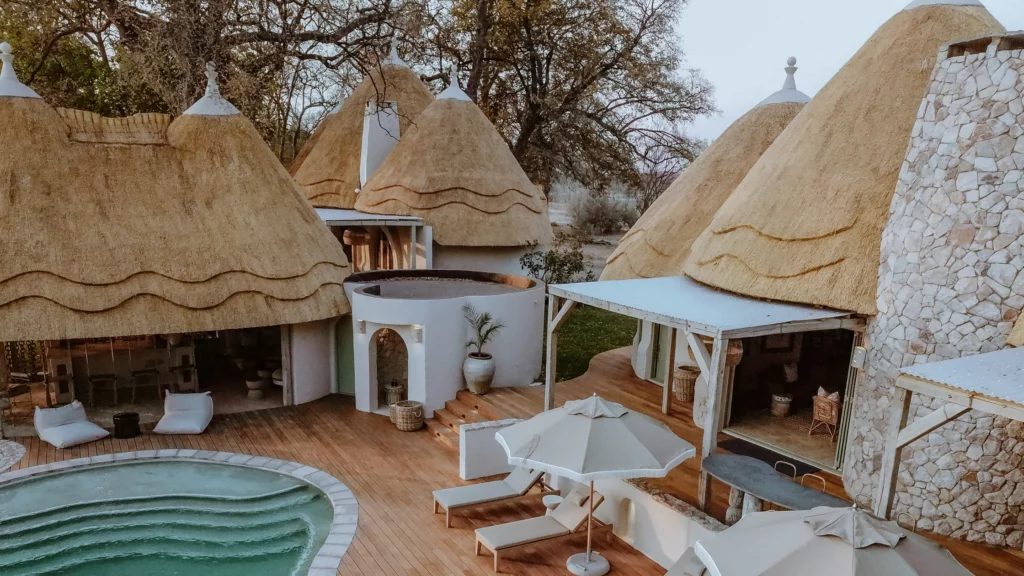
Just a few kilometres upstream, where the gurgling rapids of the Zambezi River take a breather and hippos squabble, a cluster of cone-shaped straw roofs with lime-washed walls and pastel-coloured windows appears. It is difficult to place whether the setting belongs to the pantomime world of a Mediterranean fairy tale or recalls the Trulli – traditional dry-stone, triangular-roofed dwellings found in the Valle d’Itria region of Puglia, Italy.
But Mpala Jena Private Villas are located in Zimbabwe, Africa, sans the cobbled pathways and manicured order of Italy. And yet the well-worn Italian cliché, la dolce far niente, the sweetness of doing nothing, feels uncannily relevant here.

What the setting lacks in formal landscaping, it compensates for in wilderness. Unruly bush vegetation envelops the villas, while river light filters through the leaves. Elephants and zebras occasionally wander down to the waterhole outside the villas, framed by large windows that open onto the landscape. One can sit on the couch, wrapped in a cosy blanket and reading a book, watching as the animals pause for an unhurried aperitif at the water’s edge.
These Puglia-style private huts are located approximately five kilometres from the main Mpala Jena camp, set along the banks of the Zambezi River within Zambezi National Park, near Victoria Falls in Zimbabwe.

Historically, the Trulli were used in 14th-century Italy as temporary structures by peasants as refuges from the sun, and by landowners for storage. Over time, they became a permanent fixture and ultimately the defining architectural identity of the region. Mpala Jena Private Villas, however, are no modest peasant shelters. These villas form a plush, modern address for discerning wildlife safari enthusiasts under the Great Plains Conservation umbrella, opened in August 2025.

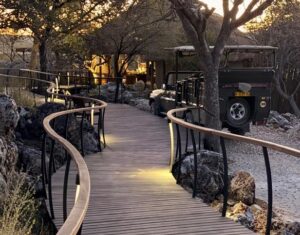
The property is a pair of villas branching off from a central thatched pavilion via raised boardwalks. Each villa is a self-sustaining cocoon of luxury that comes with a private swimming pool, a freestanding bathtub, and three luxurious riverfront suites, as well as a private butler and guide for game drives.
Mpala Jena Private Villas fall under the umbrella of Great Plains Conservation, the African eco-tourism organisation founded by National Geographic filmmaker explorers Dereck and Beverly Joubert. Sustainability in materials and a design philosophy that blurs the boundary between indoors and outdoors have long been hallmarks across their 15 properties in Botswana, Zimbabwe, and Kenya.

The camp was designed by owners Kevin and Shannon Lang in collaboration with architect Julia Rutherford and award-winning interior designer Tracy Kelly. Kelly, the principal designer of the Tracy Kelly Design firm, wanted the villas to be rooted in authenticity and restraint, drawing on the vernacular architecture of Puglia and Alberobello, which is time-tested for its simplicity, solidity and sculptural clarity. The intention was to incorporate passive design strategies, maximise natural ventilation and admit generous daylight, reducing reliance on artificial systems.

A primordial thread of the project is the biophilic design. It is experienced in open patios, ungrilled windows, long sightlines, and circular roof apertures above the showers. From these openings, a lilac-breasted roller or a malachite kingfisher peers in from above. At Mpala Jena Private Villas, it is a sense of permeability that takes you by surprise. The expansive nature of the African wilderness seeps in through light, air, sound and feathered visitors, until it becomes an intimate, daily companion, even while you remain indoors.

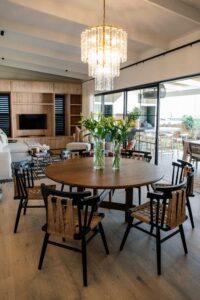
The furnishings do the same justice. Natural fibres, textured rugs and lime-washed surfaces are tempered with African craft references to anchor the spaces within their setting. Rope-wrapped furniture, handwoven raffia and palm fibres used as fringes for bespoke chandeliers, inverted basket weaves as lighting fixtures, reed-lined ceilings, and macramé ottomans contribute to the tactile finishes of the interiors, all produced locally in Swaziland.

Most Popular


As Kelly explains, each villa responds individually to its immediate environment. Villa 1 adopts a palette of layered greens drawn from the surrounding African mahogany trees. Villa 2 chimes towards the mood board of a woody spectrum inspired by the bushland in which it sits, ranging from biscuit-beige to earthy clay or Pantone colour of 2026, Cloud Dancer.
A bespoke leaf motif recurs throughout the project, appearing across multiple interior applications, developed directly from the African wilderness’ tree canopies to establish a visual link between architecture and environment.

In Villa 2, Suzani bedcovers introduce traditional Suzani patterns in the language of embroidered leaf forms derived from foliage collected on-site. The same leaves appear as framed wall art.
Kelly says, “It was difficult to achieve a balance of creating interiors that feel considered rather than styled, luxurious without excess, and culturally grounded yet contemporary. But when I see the final result, I love how the mix of old and new, cultural and weathered elements came together within the natural landscape.” @tracykellydesign_, @mpalajena_zambezi
Original Source:
https://www.admiddleeast.com/story/these-puglia-style-huts-are-your-private-pass-to-the-african-wilderness
By Shalbha Sarda February 5, 2026
Browse Tracy Kelly’s collection – a unique selection of once off, handmade items.